By Jerry Tardif
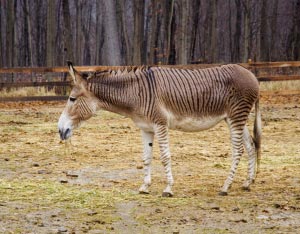
Here's an animal you may not have seen before. It's called a zedonk and is a cross-breed between a zebra and a donkey.
It is also sometimes called a zeedonk, zebronkey, zonkey, zenkey, zebadonk, zebrass, zebroid, deebra, or a Golden Zebra.
When a zebra is crossed with a horse, it's a zorse. Similarly, with a pony, it's a zeony.
About Zebras
Many people think of zebras as being nothing more than striped horses, but in fact, there are quite a few differences, particularly in personality.
Zebras are very social amongst themselves, but they have a more naturally suspicious and aggressive nature toward other species, including humans.
In fact, they are so easily spooked that you can think of them as "ultra-skittish".
This is due to their need to survive on the African plains, primarily against the big cats.
Their lives are always at risk and they must be always on the alert and not very trusting of other species to survive.
Zebras are not considered candidates for riding or any other form of human domestication.
At times, their behavior is sometimes characterized as somewhat vicious.
Back to Zedonks
Zedonks, conversely, can be ridden and are more donkey like in temperament, but reportedly, with some of the "edge" of the Zebra.
They still have much of a zebra's looks, especially those beautiful stripes.
Though, ze-donk breeders contend that you must work with them frequently to maintain their trust and milder disposition or there is some reversion to a wilder animal, though less so than a purebred zebra.
The character pictured above lives at a horse farm about 40 minutes from my home in Connecticut.
He was the size of a pony when I took this photo, perhaps in the range of 13 hh or so.
You'll notice his conformation is different than a typical horse from his thicker neck and bigger, donkey-like ears to his tail and hindquarters.
Their population in this country is reportedly only in the hundreds at this time, though interest is them growing due to the appeal of their stripes.
Besides being an avid trail rider, Jerry Tardif is a technology consultant and a horse and nature photographer in SE Connecticut — see his work at: www.jerrytardif.com.
He is also co-founder and President of QueryHorse.
Back to Article Index
|