|
By Jerry Tardif
From time to time, we can find ourselves in inclement weather.
During summers, the biggest common risk is being outside during thunderstorms (hurricanes and tornadoes not being as common).
Thunderstorms bring several risks that are dangerous individually and can be even worse together.
Lightning
The most obvious risk is lightning.
You can't see it before it arrives.
You can see other strikes, but the one that will hit you or your horse cannot be seen until it does.
By then it's too late and the most you can hope for is to see the flash so you know why you're losing consciousness — not a good idea.
This means you need to take precautions BEFORE lightning strikes — DON'T WAIT!
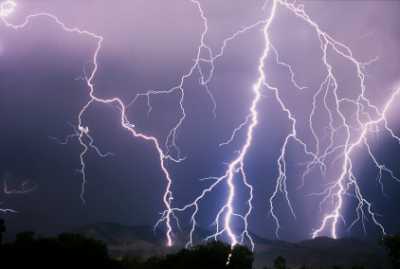
Your risk of getting struck is greater when you're sitting on your horse because you're higher off the ground and potentially higher than other targets that would otherwise attract the lightning away from you.
In addition, if lightning hits you, it will go through you and then through your horse to get to the ground; so it can take the both of you out together.
While that may sound romantic, my preference is to merely stay alive and find romance in my own way.
So, during storms, there are several things you have to do:
- Avoid open areas – In an open area, you and your horse are the highest items, and therefore, you're the likely targets;
- Avoid being near or under a single tree or a group of trees – In an open area, a single tree or small group of trees is a "sucker trap".
Because the area around is open, that tree or those trees are now the highest items.
With one or only a few trees, lightning will hit them and then one or more "stringers" (sub-bolts off the main strike) will generously include you and your horse as the main bolt's energy goes to ground.
Even a stringer can fry you both to a crisp — don't chance it;
- Avoid hilltops or mountain tops – What more need be said?
You don't really want TO BE the lightning rod in some misguided effort to protect the environment around you, do you?
So, DON'T BE the highest point in the area!
Also understand that even the side of a hill or mountain is risky, so as a storm moves in, head for lower ground; and finally
- Decide to run or hunker down – If you have time to "make a run for it", gallop home now — don't wait!
If there's not enough time, quickly get to a lower area and get off your horse to lower your overall lightning-attraction profile.
You shouldn't have left yourself exposed like this in the first place, but now that you're in the "thick of it", try to do everything you can to stay alive and get back in one piece.
A wrong decision now could be fatal.
From a lightning perspective, a large forest of trees is safer than an open area.
But remember that it's not a completely safe haven.
A strike at the upper canopy that severs a branch or the breaking of a branch from high winds will cause a falling hazard — be alert!
Flooding
While good advice to avoid lightning means heading for lower ground, you also have to consider that you want to stay away from the lowest areas, such as the bottoms of valleys and near streams, brooks, and rivers.
That's because thunderstorms also bring heavy rain and that often results in flash floods in the lowest areas as all that rain runs downhill to the bottom and starts to flow.
The key to avoiding lightning is to be lower than most objects — the key to avoiding floods is to be higher than the lowest areas — nothing's easy, is it?
High Winds
As just mentioned, high winds are another thunderstorm hazard you must try to avoid.
Branches can be broken free and fall to the ground (or onto you or your horse), trees can be toppled, and debris can be lifted and blown toward you and your horse.
When the winds really whip up, try to find some sheltered area that isn't high or alone and attracting lightning.
Spook factor
Where do I begin?
Thunderstorms provide ample phenomenon to spook a horse.
The site of lightning flashes stretching across the sky can spook a horse.
The sound of a nearby tree breaking apart from instant water expansion when lightning hits it will scare the wits out of you and your horse.
High winds can send debris and branches at you and your horse.
And let's not forget the awfully loud and scary sound of thunder from a nearby strike.
You have to admit, being out in a violent thunderstorm is sounding worse and worse, and it truly is.
Avoid Storms Whenever Possible
Never be out in a storm if you can avoid it.
Most horses will be on edge and some may be in a downright panic.
If you are out in one, try to find some form of shelter.
If debris or items of any kind come flying at you and your horse, there's likely no way you'll be able to keep him calm, as well as the risk to both of you from the flying objects themselves.
Overall, the foregoing really demonstrates that we should all avoid getting stuck outside in a thunderstorm in the first place.
A mild rainstorm is no big deal.
But a thunderstorm brings too many dangerous hazards to take lightly.
Be aware of the weather expected in your riding locale during the duration of your ride.
If it's not a good forecast, either postpone the ride or stay near the barn so you can retreat there at a moments (or a rumbles) notice.
Besides being an avid trail rider, Jerry Tardif is a technology consultant and a horse and nature photographer in SE Connecticut — see his work at: www.jerrytardif.com.
He is also co-founder and President of QueryHorse.
Back to Article Index
|