|
By Jerry Tardif
From time to time, people will ask two kinds of questions about jumping horses.
The first kind is, "how safe is it?
Should you never jump?
Or is it ok if properly trained?"
There is certainly additional risk to jumping.
In fact, your chances of getting hurt will triple — yes, you read that right — TRIPLE!
Still, many people jump horses over the years with not much more than an occasional bruise.
If you're going to jump, you should accept that you will likely take a fall from time to time.
The second kind of question we hear generally asks from the horse's point of view:
"Will jumping hurt a horse?"
There are no simple answers to these questions because it depends on the circumstances.
As you certainly know, horses can jump.
They know how to do it and it's part of their natural abilities as is walking, running, rearing, and so forth.
In the wild, horses jump only when they need to do so.
That is, if they're being chased and they have to go over a fallen tree, fence, or some other obstacle.
Generally, they'll go around an object if they can and jump only when necessary.
Now, let's introduce humans into the equation.
|
|
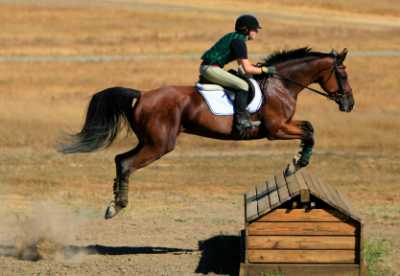
A Cross Country Jumper in Competition
|
We like to jump our horses when we're riding.
It's one of the few ways we can experience the sense of flying and to a much greater degree than when we jump by ourselves.
Horses usually get hurt jumping when we unbalance or miscue them during a jump, or make them jump higher than they should, make them jump too often, or make them jump when they shouldn't be jumping (they have an injury, soft or porous bones, on slippery surfaces, etc.)
Even if we do everything right, injuries can still occur because jumping introduces a higher level of risk for us and our horse, just as galloping does.
Still, that doesn't necessarily mean we should never jump or gallop.
Unless we do nothing in life, escalating into more dynamic activities always presents some risk.
But jumping raises that to a level higher, in fact, the risk of injury triples when we jump, especially as we jump higher and/or approach the jump faster.
So, if you want to jump your horse, do it wisely:
- Have your veterinarian check your horse to assure his hooves and legs are healthy and ok to jump;
- Have your farrier inspect your horse's hooves and feet to assure they're in good shape and have him trim and dress them as necessary.
If your farrier recommends shoes for jumping or any other advice, take it;
- Make sure your horse is in good physical condition for jumping the day you plan to jump (no injuries or soreness, properly rested, properly fed, etc.);
- Make sure your horse is in a proper state of mind at the time you plan to jump (not high-strung or easily spooked);
- Make sure YOU'RE WEARING a properly fitting ASTM/SEI approved helmet in good shape and proper footwear;
- You should also wear an approved jumping vest to reduce the chance of injury in case you do fall off;
- Take lessons yourself to learn to jump your horse properly;
- Make sure you're using the proper tack for jumping, you've placed and secured it properly on your horse, and you've included boots or other recommendations of your vet and farrier.
You also should shorten your stirrups a little when jumping so you clear the front of your saddle and can use your legs to absorb the shock of the landing without your butt slapping the saddle;
- Don't jump your horse too high or too frequently; and
- Make sure you only jump your horse where you know the ground conditions are safe.
That means you've inspected the run-up and the area from where the horse will leave the ground, you've inspected the object you're jumping over, and the area and footing where you're going to land.
Don't jump there if the ground is too soft, too hard, too slippery, or has holes or objects sticking up (rocks, stumps, or anything else).
In most cases, if you follow the above suggestions, you and your horse should do fine with jumping.
DON'T JUMP ANYTHING, ANYWHERE WHEN YOU'RE NOT COMFORTABLE.
When you feel that way, it's your subconscious warning you that something is not right — TRUST THAT FEELING AND DON'T JUMP until you've corrected the problem(s) and know things are ok.
|
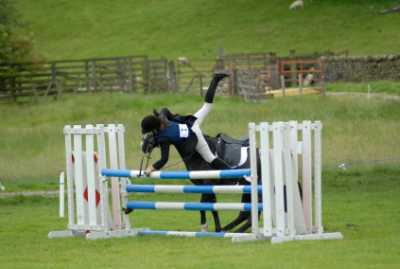
Jumping Does Have It's Risks
(In This Case, the Horse Balked at the Jump and the Rider Kept Going)
|
As your horse gets older, you'll have to jump less high and less frequently.
Even if you take all the precautions discussed, there are no guarantees you or your horse won't get hurt.
But it should reduce the chances of problems.
And if you decide that jumping is not in your future, that's ok, too.
Many riders experience the great fun of horses and riding without ever leaving the ground and minimize the risks of riding overall.
Besides being an avid trail rider, Jerry Tardif is a technology consultant and a horse and nature photographer in SE Connecticut — see his work at: www.jerrytardif.com.
He is also co-founder and President of QueryHorse.
Back to Article Index
|